A Blog for the information of USSVI First Coast Base membership in Jacksonville, FL.
No user data is collected in this blog.
USSVI Creed
USSVI Creed: "To perpetuate the memory of our shipmates who gave their lives in the pursuit of their duties while serving their country. That their dedication, deeds and supreme sacrifice be a constant source of motivation towards greater accomplishments. Pledge loyalty and patriotism to the United States of America and its Constitution."
This will be the final post of the Blo-n-Go Blog. Thank you to all that expressed interest in the postings.
COPENHAGEN, Denmark — Denmark's military says its arctic command forces evacuated a crew member of a U.S. submarine off the coast of Greenland for urgent medical treatment.
The Danish Joint Arctic Command, on its Facebook page, said the crew member was evacuated on Saturday some 7 nautical miles (8 miles; 13 kilometers) off Nuuk — the capital of the vast, ice-covered territory — and transferred to a hospital in the city. The crew member was retrieved by a Danish Seahawk helicopter that had been deployed on an inspection ship.
What You Need to Know: The UK’s Astute-class submarines are among the most advanced and quietest in the world, rivaled only by the U.S. Navy. Equipped with Tomahawk cruise missiles and Spearfish torpedoes, these submarines can launch precise strikes from 1,000 miles away and operate undetected thanks to over 39,000 acoustic tiles that mask their sonar signature.
Powered by a nuclear reactor with a 25-year lifespan, they possess unlimited underwater endurance, allowing global circumnavigation without surfacing.
Each submarine’s cutting-edge technology includes advanced sonar, electronic countermeasures, and a dry deck shelter for Special Forces, cementing their role as formidable assets for the Royal Navy.
How the Astute-Class Submarines Redefine Underwater Warfare
The Astute class are among the most capable submarines in service today.
Each boat is equipped with world-leading sensors, carries Tomahawk Land Attack Cruise Missiles and Spearfish heavyweight torpedoes, and can circumnavigate the globe submerged, producing its own oxygen and drinking water.
Only the U.S. Navy can match these underwater warships.
As noted by naval analyst H I Sutton, the Astute-class subs are the only ones outside the U.S. Navy able to launch the Tomahawk, a capability that truly sets them apart.
Quite Astute
The Astute-class program began in February 1986 when the Ministry of Defence (MOD) launched a number of studies intended to determine the capabilities and requirements for the replacement of its Swiftsure and Trafalgar-class fleet submarines.
Each of the submarines costs a reported £1.6 billion to build, but the capabilities offered are essentially priceless. The Astute-class boats are roughly 97 meters (318 feet) in length and have a crew of around 100 sailors, with a capacity for 109 in total.
5G Home Internet plans in your area starts at $35/mo w/ AutoPay & select 5G mobile plans.
The final two of the planned seven of the class, the future HMS Agamemnon and HMS Agincourt, are now under construction in Barrow, England. The boats are being constructed by BAE Systems Submarines at Barrow-in-Furness and the first of class, HMS Astute, was launched by Queen Consort Camilla, then-Duchess of Cornwall, in 2007. The submarine was commissioned in 2010 and declared fully operational in May 2014.
Each of the Royal Navy's nuclear-powered Astute-class fleet submarines (SSNs) has been outfitted with many technological firsts, including not having an optical periscope.
Instead, high-specification video technology has been employed, which enables the crew to scan the horizon and get a 360-degree view to address any potential threat.
In addition, unlike other nuclear-powered submarines, the Astute-class was developed to utilize state-of-the-art anti-acoustic tiles. Each hull is fitted with more than 39,000 acoustic tiles that mask the vessel’s sonar signature and allow the submarines to glide through the water almost silently.
The little noise the boats give off has been compared to that of a "baby dolphin."
Unlimited Endurance
The fleet attack submarines are powered by a Rolls-Royce PWR2 (Core H) reactor and fitted with a pump-jet propulsor, the same reactor that was developed for the Royal Navy's Vanguard-class ballistic missile submarines.
That particular nuclear reactor, which powers the submarines and has a 25-year lifespan before needing to be refueled, is also used to recycle air and water. It provides a theoretically unlimited endurance for the submarine and can circumnavigate the globe without surfacing. Each of the boats is typically supplied with about 90 days of food.
As deployments on the submarines can vary in length, with overall assignments lasting three years, two full crews rotate shifts to allow the vessel to remain at sea for as long as possible.
Crews may serve between 60 and 80 days before resurfacing and rotating out.
True Attack Subs for the Royal Navy
The Astute-class submarines have stowage for 38 weapons and typically carry a mix of Spearfish heavy torpedoes and Tomahawk Block IV cruise missiles, with the latter capable of hitting a target within a few meters, to a range of 1,000 miles (1,600 km). The missiles can be also re-directed at a new target mid-flight, and can "beam" back images of the battlefield to its mother sub.
Each of the boat's Spearfish heavyweight torpedoes – which are nearly two tonnes – can further attack targets up to 14 miles away (which can increase to 30 miles at low speed) and is capable of blowing an enemy submarine clean out of the water. Guided by either copper wire or inbuilt sonar, the Spearfish delivers 660 lbs of explosive charge either when it impacts with the intended target or via an acoustic proximity fuse underneath.
The submarines' countermeasures suite includes decoys and electronic support measures (ESM).
Moreover, the Astute Combat Management System (ACMS), which is an evolved version of the Submarine Command System (SMCS) used on other Royal Navy subs, was developed to receive data from sonars and other sensors and, using advanced data handling and algorithms displays this data as real-time images on the command consoles.
For detecting enemy vessels, the Astute-class submarines are equipped with Sonar 2076 - an integrated passive/active search and attack sonar suite with bow, intercept, and towed arrays.
The Astute-class boats are also fitted with a dry deck shelter, which allows Special Forces – such as the Royal Marine Commandos or Royal Navy Special Boat Service (SBS) operators – to deploy whilst the submarine is submerged.
Legendary U.S. WW II Submarine Found 3,000 Feet Underwater 80 Years After Fierce Battle With Japanese Ship
The Naval History and Heritage Command had recently announced their joyful discovery of a U.S. World War II submarine. The submarine, USS Harder—nicknamed 'Hit 'em HARDER'—was found near the Philippine Island of Luzon, 3,000 feet underwater, sitting upright and mostly undamaged. Tim Taylor, CEO of the Lost 52 Project, had led the team that located it.
According to CBS News, NHHC Director Samuel J. Cox, a retired U.S. Navy admiral, said in a press release, "Harder was lost in the course of victory. We must not forget that victory has a price, as does freedom." He added, "We are grateful that Lost 52 has given us the opportunity to honor once again the valor of the crew of the 'Hit 'em HARDER' submarine that sank the most Japanese warships—in particularly audacious attacks—under her legendary skipper, Cmdr. Sam Dealey."
Knewz.com noted that Tim Taylor, along with diving expert Christine Dennison, had used advanced imaging tools and underwater robots to find and capture incredible images of the Harder. The submarine had been sunk off the coast of the Philippines by Japan in 1944 during World War II. NHHC stated, "Submarines, by their very design, can be challenging to identify, but the excellent state of preservation of the site and the quality of the data collected by Lost 52 allowed NHHC to confirm the identity of the wreck as Harder."
Tim Taylor and his team had also located other lost World War II submarines, including the USS Grayback, USS Stickleback, and USS Grunion. In recognition of his efforts, Taylor received a Distinguished Public Service Award from the Navy in 2021.
The USS Harder, commanded by the renowned Commander Samuel D. Dealey, had gained fame for sinking three Japanese destroyers and damaging two others within four days. However, Harder’s luck changed in 1944. On August 22, Harder and the USS Haddo sank three escort ships near Bataan. Later that night, Harder, Haddo, and USS Hake headed toward Caiman Point on Luzon. On August 24, Haddo and Hake evaded enemy ships, but Harder remained and fired three times at an escort ship, missing each shot. The escort ship then attacked with depth charges, sinking the Harder and killing all 79 crew members.
According to CNN, the National Medal of Honor Museum described Dealey’s tactics: "At 1,500 yards, Dealey fired three torpedoes and ordered the sub to dive. As the Harder passed 80 feet underneath the destroyer, two of the torpedoes struck the ship, sending shock waves through the submarine." Harder’s achievements earned it a Presidential Unit Citation for its first five missions and six battle stars during World War II. Its courageous commander, Dealey, was posthumously awarded the Medal of Honor, a Navy Cross, two Gold Stars, and a Distinguished Service Cross.
The waters around the Philippines had seen many shipwrecks. In 2015, U.S. billionaire Paul Allen discovered the Musashi, one of Japan’s largest warships, in the Sibuyan Sea. Just last September, explorers had documented images of three shipwrecks from the Battle of Midway, including the first close-up photos of a Japanese aircraft carrier sunk in 1942.
On board the USS Alaska in 2010, the year that a law barring women from serving aboard submarines was dropped. Image used for illustration purposes. Stephen Morton/AP Photo
The USS New Jersey, designed for a co-ed crew, is set to join the US fleet on Saturday.
A ban on women serving on US submarines was lifted in 2010, leading to hundreds joining the service.
Future US submarines will be gender-neutral, addressing privacy and space issues for co-ed crews.
A submarine designed to fully integrate male and female sailors is set to join the US fleet on Saturday.
The USS New Jersey "is the first Virginia-class submarine designed and built for a full gender integrated crew," according to Naval Sea Systems Command.
Delivered last April after eight years of construction, it will enter active service on September 14, following a ceremony at Naval Weapons Station Earle in New Jersey.
A long-standing ban on women serving aboard US submarines was lifted in 2010, and as of 2023 there were 609 women assigned to submarines in operation, per the US Naval Institute.
"The submarine community is a fully gender-integrated warfighting force," said Vice Admiral Robert Gaucher, commander of Submarine Forces Atlantic, according to Stars and Stripes.
Gaucher added, per the outlet, that all future nuclear-powered attack submarines and all new Columbia-class ballistic missile submarines are to be designed "gender-neutral from the keel up."
For the New Jersey, that meant adjusting many details, from the height of overhead valves to the privacy of washrooms and berths, the outlet reported.
Since admitting women onto submarines, the US Navy has faced the challenge of retrofitting and reorganizing vessels for co-ed use.
Last year, the Navy announced plans to expand the number of submarines taking on co-ed crews from 30 to 40, the Navy Times reported.
Lieutenant Commanders Andrea Howard and Emma McCarthy, who joined the influx of women to the fleet, wrote last year about the adjustments needed — both physical and social — in integrating them on ships designed for all-male crews.
Space is tight, and the distribution of bathrooms and berths doesn't always match the crew's needs, they wrote.
"The number of women on board often does not conform to three- or six-man rack configurations," they said.
Similar issues apply to the washrooms, with some crews dividing up the space and others deciding to use them in all-male and all-female blocks.
"Transit to and from these spaces for showering also warrants an unambiguous, uniform standard for decency," they said.
But the physical arrangement of a submarine was only part of the issue — the workplace culture also needed to adapt, they said.
"Crew reactions ranged from treating the women the same, to making the experience awkward (knowingly or unwittingly), to showing disinterest in helping or—at worst—actively subverting," they wrote.
The first influx of female junior officers also drew sometimes awkward curiosity from male crew members, they said.
"A fishbowl effect developed any time one of the first female junior officers did something for the first time," they wrote.
The USS New Jersey is the 23rd Virginia-class submarine and the third Navy vessel to be named after the state. In 1900, New Jersey was the site of the construction of the first-ever US submarine
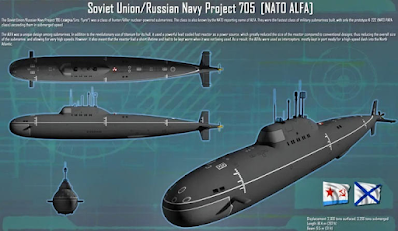
The Alfa-class submarine, developed by the Soviet Union during the Cold War, was an innovative but problematic vessel. Its titanium hull and unique lead-bismuth-cooled reactor allowed it to achieve record-breaking speeds and deep diving capabilities, making it one of the fastest submarines of its time.
However, the Alfa-class faced significant drawbacks, including noisy operation, complex maintenance, and radiation risks to its crew.
Despite these issues, the Alfa-class remained in service for over 30 years.
Though it proved to be a menace to NATO forces, it was hampered by the very technologies that made it exceptional.
The Alfa-class Submarine was a Nuclear Nightmare for the Soviets
The Cold War era saw some incredible advances in technology in both the Soviet Union and the United States, notably in the area of submarine research and development. Project 705 Lira, or the Alfa-class submarine that was built for the Soviet Navy, was one such advancement. Considered highly innovative for its time, this ambitious Cold War-era project possessed a unique titanium hull and high-speed capabilities.
But its innovative design was tempered by operational challenges.
Alfa-class submarines were meant to be a counterweight to NATO’s various fast-attack subs, notably the ubiquitous Los Angeles-class submarines. The Alfa-class submarine’s primary role was to serve as an interceptor. In other words, it would hunt down and destroy enemy submarines.
Soviet designers wanted the Alfa class to achieve high underwater speeds. The goal was to make a boat that could outrun and outmaneuver any of its American or NATO rivals, either underwater or on the surface.
This hull could go deeper and faster than the steel hulls that most submarines for either the American or Soviet navies could go. Not only does titanium allow for greater speed because it is lighter, but it can withstand greater pressure than can steel.
These boats could go an average of 46 miles per hour (40 knots), earning the Alfa-class submarine the title of being the fastest submarine in the world for its time. The lighter-weight titanium hull was but one reason for the high speed. Soviet engineers installed a powerful liquid-metal cooled reactor, too.
These two factors operating in tandem ensured the high rate of speed for the sub.
Speaking of reactors, the Alfa class had a unique nuclear-powered reactor. Whereas most submarines use water-cooled reactors as a power source, the Alfa-class was designed with a lead-bismuth-cooled fast reactor. This unique coolant system meant that the boat could be equipped with a smaller reactor, which allowed the Alfa class to travel at faster speeds.
And here is where we get to the drawbacks.
As innovative as the Soviets were when it came to designing nuclear reactors, the Reds were also quite sloppy in their application. I mean, how many nuclear disasters, both at sea and on land, did the Soviet Union endure?
And I’m not just talking about Chernobyl.
Anyway, the reactor on the Alfa-class submarine was one of the biggest drawbacks when it came to operating this boat. Notably, the smaller, lead-bismuth-cooled nuclear reactor created polonium-210 as an unfortunate byproduct. So the submarine could move faster underwater and dive deeper than its rivals, but the longer the crew operated the boat, the greater their exposure to lethal radiation poisoning.
The Nuclear Reactor was a Hot Mess—Literally
Indeed, as Peter Suciu outlined in these pages just a few weeks ago, an Alfa-class submarine designated K-64, the lead boat of this submarine class, suffered a massive reactor failure in 1972. The issue with the lead-bismuth-cooling was that the alloy needed to be constantly heated to prevent it from cooling, solidifying, and basically backing up the reactor. When the reactor on K-64 leaked, the metal alloy solidified as soon as it hit the cooler air outside the reactor.
The leak was so bad that it effectively damaged the surrounding components, compromising the integrity of the K-64.
Soviet engineers opted to mothball the sub rather than try to rebuild it. Interestingly, part of the decommissioning process involved cutting the submarine in half and sending the forward section – with all the controls – to the Soviet Navy’s submarine warfare training center in Leningrad.
Setting aside the K-64 fiasco, even on Alfa-class submarines that operated “within norms,” the liquid-metal coolant was corrosive, which created massive maintenance woes for the ship.
Other problems related to maintaining the submarines. Its greatest strength, the titanium-alloy hull, was also its greatest weakness. Welding the submarine’s hull was a complex affair. As such, it was prone to cracking. That’s definitely not something you want to have occur on any ship – especially one that has a primary function of operating below the waves.
Even if everything was operating according to design specifications, these boats were unsafe. Long-term exposure to unsafe levels of radiation posed significant health risks to the crew. Over time, those who did continuous deployments aboard the Alfa-class subs suffered health declines as a result of constant exposure to polonium-210.
Oh, and the internal temperatures of the submarines as a result of the output of the reactor created hellish conditions for the crews.
Run Toxic (and Loud), Run Deep
One of the primary purposes of any submarine is stealth. But the Alfa class was one of the noisiest submarines the Soviets produced during the Cold War. In effect, the Alfa class, despite its high rates of speed and innovative hull design, failed in the paramount mission of any submarine. These boats were way too noisy beneath the waves, meaning rivals could hear them coming from over the horizon.
So the Alfa class gets high marks for innovation, maneuverability, and speed. But the boat failed to deliver on key elements necessary for any submarine – namely stealth – and the Alfa was notoriously unsafe because of the very elements that gave the bot its greatest advantages: its unique hull and nuclear reactor.
Still, the Alfa class served for more than 30 years, with the final units being retired in 1996. These boats were dangerous for their crews and didn't always work to specifications. But they did last decades in service, and they proved to be a continual menace to NATO ships.
The Navy received the New Jersey, its 23rd Virginia-class, fast-attack submarine in April 2024. The first fully integrated sub for mixed-gender crews, the New Jersey will join the fleet on Sept. 14, 2024, during a commissioning ceremony. (Ashley Cowan/Newport News Shipbuilding)
WASHINGTON — The first submarine fully integrated for mixed gender crews will join the Navy fleet next week during a commissioning ceremony in its namesake state of New Jersey.
The future USS New Jersey, a fast-attack submarine, will become a deployable part of the Navy’s force during the ceremony at Naval Weapons Station Earle in New Jersey on Sept. 14, culminating five years of construction that represents a historic shift in how Navy submarines are designed.
The New Jersey is the 23rd Virginia-class submarine, but it is the first of its kind — designed from the keel up with specific modifications for gender integration. “The submarine community is a fully gender-integrated warfighting force,” said Vice Adm. Robert Gaucher, commander of Submarine Forces Atlantic.
Modifications included obvious ones — more doors and washrooms to create separate sleeping and bathing areas — and some that are more subtle — lowering some overhead valves and making them easier to turn and installing steps in front of the triple-high bunk beds and stacked laundry machines.
The design changes were made to accommodate the growing female force of submariners. In the past five years, the Navy has seen the number of officers and enlisted sailors in the submarine force who are women double and triple, respectively, Gaucher said.
As of August 2024, 730 women were assigned to operational submarines — serving as officers and sailors on 19 nuclear-powered, ballistic-missile and guided-missile submarines, and 19 nuclear-powered attack boats, according to Submarine Forces Atlantic. The increase follows the 2010 lift of the ban that barred women from serving aboard submarines.
A decade later, in 2021, the Navy announced a long-term plan to integrate female officers on 33 submarine crews and female enlisted sailors on 14 submarine crews by 2030. “To support women serving onboard submarines, the submarine force, starting with [the Pre-Commissioning Unit] New Jersey, is building all future [nuclear-powered attack submarines] and the new Columbia-class, [ballistic-missile submarines] gender-neutral from the keel up,”
Gaucher said. Construction on the New Jersey began in 2019 at HII’s Newport News Shipbuilding division in Virginia. The warship was christened in 2021 and delivered in April to the Navy at Naval Station Norfolk in Virginia.
Before construction of the New Jersey, the Navy retrofitted existing Ohio-class submarines with extra doors and designated washrooms.
Read more at: https://www.stripes.com/branches/navy/2024-09-05/navy-sailors-submarine-women-15079956.html